Last updated:
Why a Brahmin biodata has extra fields
Brahmin families usually avoid marriage within the same gotra (sagotra) and often within the same pravar, so these lines are checked first. Many families also note their Ved and shakha, which reflect the family's Vedic tradition, and their kuldevta. Adding them up front saves a round of phone calls.
Brahmin-specific fields
- Gotra: e.g. Kashyap, Bharadwaj, Vashishtha, Vatsa, Gautam, Atri, Shandilya, Jamadagni.
- Pravar: the rishis of your gotra line, e.g. for Kashyap gotra "Kashyapa, Avatsara, Naidhruva".
- Ved: Rigveda, Shukla Yajurveda, Krishna Yajurveda, Samaveda or Atharvaveda.
- Shakha: e.g. Shakala (Rigveda), Madhyandina or Kanva (Shukla Yajurveda), Taittiriya (Krishna Yajurveda).
- Sutra (optional): e.g. Ashvalayana or Apastamba.
- Kuldevta / kuldevi: e.g. Tuljabhavani, Khandoba, Mahalakshmi (Kolhapur), Mangueshi.
- Sub-caste: Deshastha, Chitpavan (Konkanastha), Karhade, Saraswat, Kanyakubja, Saryupareen, Gaur, Maithil, Iyer, Iyengar and so on.
- Horoscope: rashi, nakshatra, charan, gan, nadi and manglik, as in the Hindu marriage biodata.
How to set it up
- Open the biodata maker. The Hindu preset (Design tab, Religion preset) is the default, with "|| Shree Ganeshaya Namah ||" and the Ganesha symbol.
- In the Religion / Caste field, write e.g. "Hindu, Deshastha Rigvedi Brahmin".
- Gotra is already in the horoscope section, with a dropdown list. Use "Add field" to add Kuldevta (it gets a dropdown too), Pravar, Ved and Shakha, then use the up and down arrows to put them in order.
- Add Gan, Nadi and Charan fields if your family matches them; gan and nadi come with dropdown lists.
Sample Brahmin marriage biodata
| Field | Example |
|---|---|
| Name | Aditya Shrikant Joshi |
| Date of Birth | 21 July 1994, 5:30 AM, Pune |
| Height | 5' 9" (175 cm) |
| Caste | Hindu, Deshastha Rigvedi Brahmin |
| Gotra | Kashyap |
| Pravar | Kashyapa, Avatsara, Naidhruva |
| Ved / Shakha | Rigveda / Shakala |
| Kuldevta | Tuljabhavani |
| Rashi / Nakshatra | Karka / Pushya, charan 3 |
| Gan / Nadi | Dev / Madhya |
| Manglik | No |
| Education | M.Tech (Computer), IIT Madras |
| Occupation | Senior Engineer, Google, Bengaluru |
| Father | Shrikant Vasant Joshi, Retired Professor |
| Contact | +91 98XXX XXXXX (father) |
Family details in a Brahmin biodata
Along with parents and siblings, Brahmin families usually include the mama (maternal uncle) with his town and, often, the mother's maiden gotra, since some families avoid that gotra too. The family's native place and, for Maharashtrian families, the devak can also be written. If the family has a tradition of priesthood, teaching or a particular profession, one short line is enough.
Expectation lines for a Brahmin biodata
- "Looking for a well-educated Brahmin girl from a cultured family; different gotra essential."
- "Deshastha or Konkanastha preferred; horoscope matching required."
- "Vegetarian family preferred."
- "Looking for a professional, settled in Pune, Mumbai or abroad."
Common mistakes to avoid
- Writing only the gotra when the other family also checks pravar and nadi.
- Spelling the gotra differently from how elders say it; use the common form, such as Kashyap or Bharadwaj.
- Filling so many extra fields that the biodata runs onto a second page.
Horoscope matching in Brahmin families
Most Brahmin families match kundali using ashtakoot guna milan, where nadi carries the most weight and a match with the same nadi (nadi dosha) is usually avoided. That is why gan, nadi, nakshatra and charan matter as much as gotra. The biodata lists these details clearly, and you can add the optional birth chart (planets per house, or a photo of the kundali) so the family astrologer has everything in one place. Double-check the birth time with the birth record, since a small difference can change the nakshatra or charan.
Suitable templates
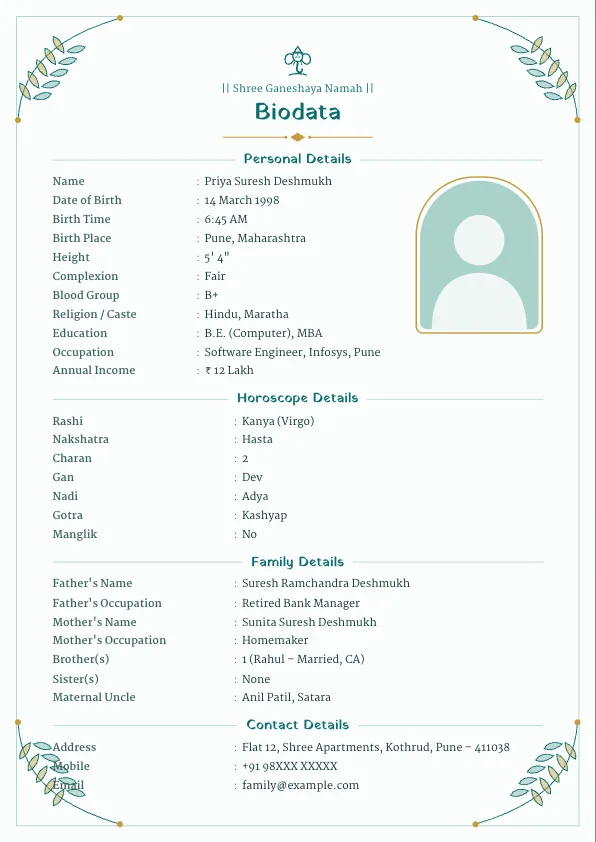
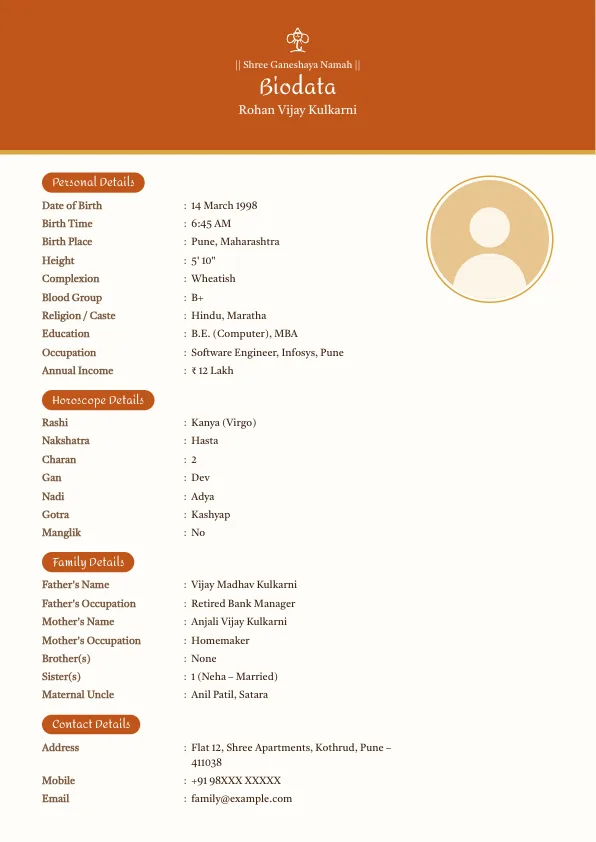
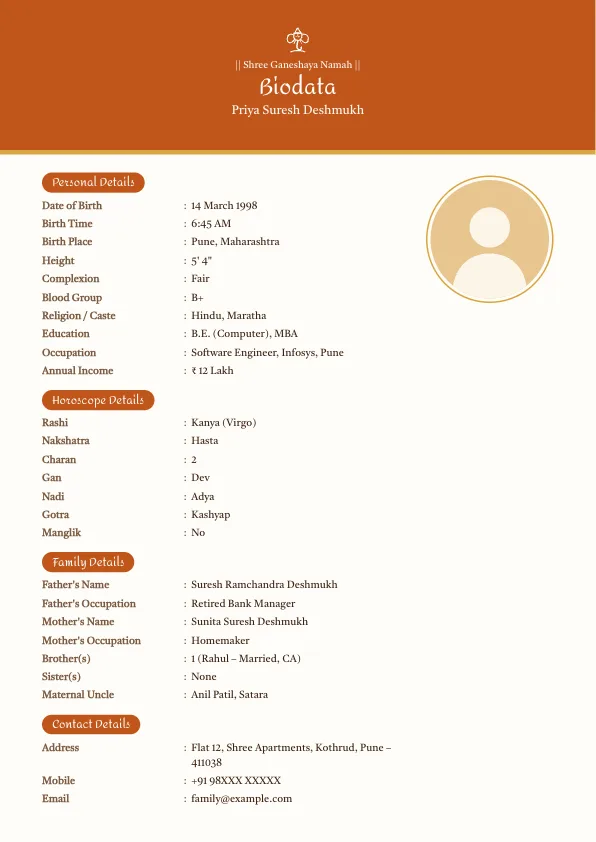
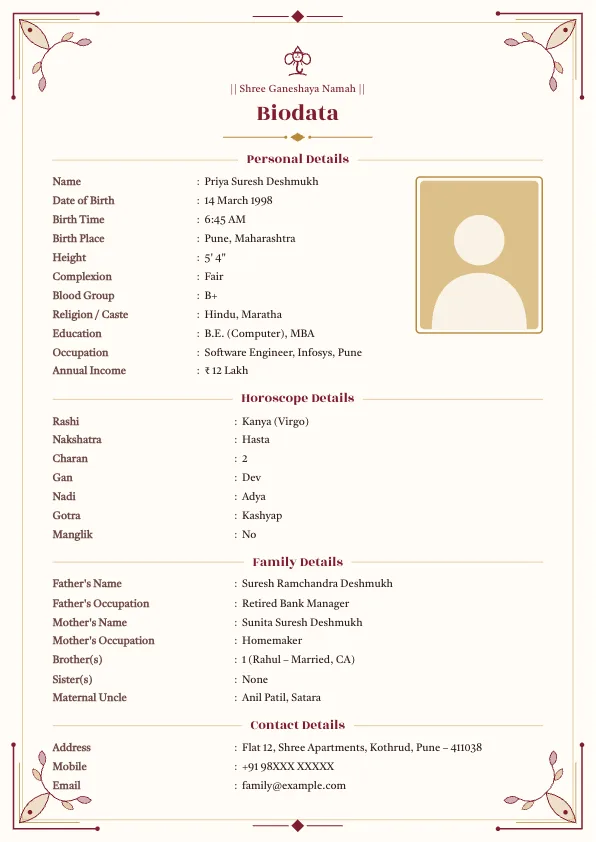
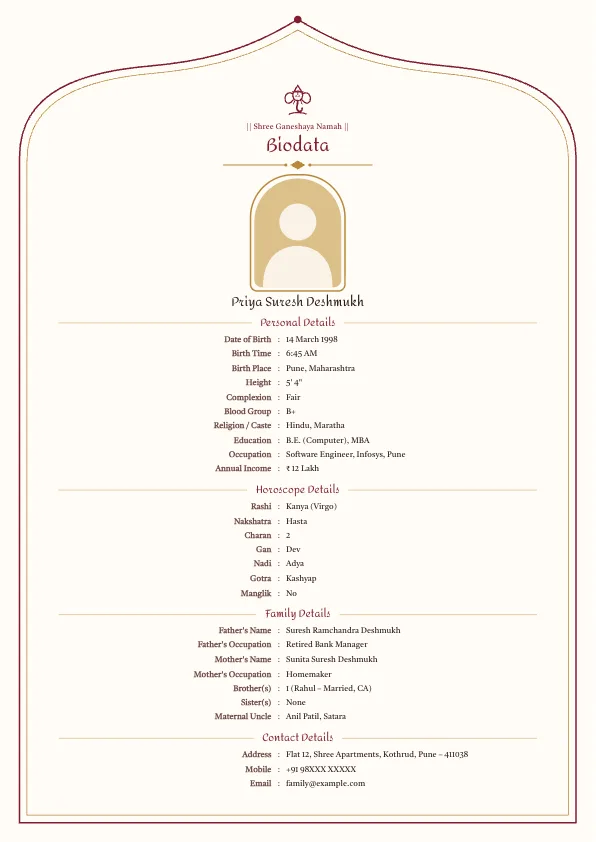
Traditional saffron and maroon designs are a natural fit. Kesari Band keeps things neat with a coloured banner; the premium Maroon Arch adds a temple-style frame.
Tips
- If you are unsure of your pravar, shakha or Ved, ask paternal elders or the family purohit; don't guess. Leave the field out rather than writing something wrong.
- Keep the extra lines short so the biodata still fits one page.
- Maharashtrian Brahmin families may prefer the Marathi biodata maker, which already has देवक, कुलदैवत and गोत्र fields.
Frequently asked questions
What is pravar in a Brahmin biodata?+
Pravar lists the rishis (usually three or five) associated with your gotra line. Families use it along with gotra to avoid marriages within the same lineage.
How do I add pravar, shakha and ved fields?+
Use Add field in the horoscope section and type the label, such as Pravar, Ved or Shakha. Use the up and down arrows next to each field to reorder them.
What if I don't know my shakha or pravar?+
Ask paternal elders or your family priest. If no one is sure, leave the field out; gotra alone is enough for many families.
Can I add my kuldevta photo at the top?+
Yes. Upload a photo of your kuldevta or Ganesh ji in the symbol area, and change the top line to your kuldevta's name if you like.
More biodata formats
- Marriage Biodata Format
- Biodata for Marriage for Girl
- Biodata for Marriage for Boy
- What to Write in a Marriage Biodata
- Marriage Biodata Word Format (Free Download)
- Muslim Marriage Biodata Maker
- Hindu Marriage Biodata Format
- Jain Marriage Biodata Format
- Christian Marriage Biodata Format
- Sikh Marriage Biodata Format
- Biodata for Second Marriage
- Marriage Biodata Without Photo
- Kundali Matching: 36 Guna Milan Calculator
- Rashi & Nakshatra Calculator: Find Rashi, Nakshatra and Lagna by Birth Date
- Wedding Invitation Maker
- Vivah Muhurat 2026–2027: Hindu Marriage Dates, Month by Month
- Biodata for WhatsApp: Copy-Ready Marriage Biodata Text
- English to Marathi and Hindi Typing
- Height Converter: Feet and Inches to cm (and Back)
- Age Gap Calculator for Marriage
- Free tools for biodata and wedding planning